Please wait...

Learn

Finding accredited CPD

Foundations of hair & scalp - anatomy & function 1

Description

Foundations of Hair & Scalp: Anatomy & Function 1 introduces the fundamental biological principles underlying hair growth, follicular anatomy and scalp physiology. The course is designed for clinicians and health professionals seeking a deeper understanding of hair and scalp function in order to recognise and manage hair disorders with greater confidence.

Hair is not simply a cosmetic structure — it is a complex mini-organ with specialised cellular structures, immune regulation, vascular supply and cyclical growth phases. Understanding these systems is essential for interpreting hair loss conditions, inflammatory scalp disease and follicular pathology. This course bridges foundational science with clinical relevance, helping practitioners understand how disruptions in normal hair biology can lead to disorders such as alopecia, folliculitis and scarring alopecias.

The course is delivered through three comprehensive units that progressively build knowledge from core anatomy to complex biological signalling pathways involved in hair growth.

Unit 1: Follicular Unit and Pilosebaceous Anatomy

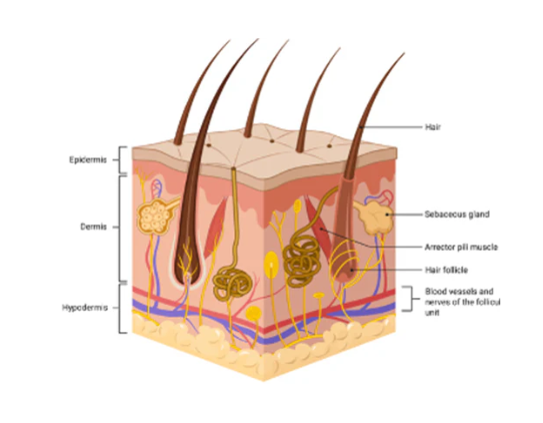
This unit introduces the structural organisation of the hair follicle and the surrounding components that together form the follicular unit and pilosebaceous unit.

Participants will explore:

  • The structure and development of the hair follicle and its epidermal origins
  • Key cellular components including epithelial keratinocytes, dermal papilla cells and follicular stem cells
  • The anatomy of the pilosebaceous unit, including the sebaceous gland and arrector pili muscle
  • The role of sebum in maintaining hair shaft integrity and scalp barrier function
  • The three anatomical zones of the follicle — the infundibulum, isthmus and inferior segment — and their diagnostic relevance in hair pathology
  • The structure and function of the inner and outer root sheaths and how they influence hair shape and stability

The unit also highlights how specific inflammatory patterns within different follicular zones can help identify various hair disorders.

Unit 2: Immunology, Innervation and Vascular Supply of the Follicular Unit

Unit two examines the complex biological systems that support and regulate the follicle, including the immune environment, neural supply and blood circulation.

Key topics include:

  • The concept of immune privilege of the hair follicle, which protects follicular structures from autoimmune attack
  • The mechanisms that maintain immune tolerance, including reduced antigen presentation and local immunosuppressive signalling
  • How disruption of immune privilege contributes to conditions such as alopecia areata
  • The sensory and autonomic nerve supply of the hair follicle and its role in tactile sensation, piloerection and glandular activity
  • The vascular network surrounding the follicle, particularly the dermal papilla capillaries that supply oxygen and nutrients to rapidly dividing follicular cells

This unit provides critical insights into how immune, neural and vascular systems interact to support healthy hair growth.

Unit 3: Understanding the Hair Cycle

The final unit focuses on the physiology of the hair growth cycle and the molecular pathways that regulate follicular activity.

Participants will learn about:

  • The four phases of the hair cycle: anagen (growth), catagen (transition), telogen (resting) and exogen (shedding)
  • The cellular mechanisms that drive hair production during the anagen phase
  • Key signalling pathways regulating hair growth, including the Wnt/β-catenin pathway, sonic hedgehog signalling and other growth factor pathways
  • Extrinsic and intrinsic factors that influence hair growth, including hormones, medications, nutrition and inflammatory signals
  • Clinical conditions associated with hair cycle disruption such as anagen effluvium and telogen effluvium

This unit integrates molecular biology with clinical practice, helping practitioners understand how changes in signalling pathways can influence hair density, growth and shedding.

Participants who complete the course will gain a strong scientific foundation in hair and scalp biology, providing an essential platform for further study and clinical practice in medical trichology and hair disorders.


Learning Outcomes

  1. Differentiate between types of skin and types of hair and evaluate disorders
  2. Determine the anatomy of hair shafts, the hair cycle and assess problems.

Details

Cost: Please refer to Healthcert's website
Suitable for: All degree qualified medical practitioners
Study mode: 100% online
 
Disclaimer: Please note, once you click 'Register now' you will be leaving the AMA’s CPD Home website and entering a third-party education provider’s website. If you choose to register for this learning, you will need to provide some of your personal information directly to the third-party education provider. If you have any queries about how third-party education providers use, disclose or store your personal information you should consult their privacy policy.
 
Upon completion, your CPD activity record may take up to 4 weeks to be reflected on your CPD Home Dashboard.   

Provided by


CPD Activity Details
Topic
General Practice and Primary Care
CAPE Aspects
Professionalism
Effective Year

Educational Activities (EA) - 4.30

Reviewing Performance (RP) - 6.0

Measuring Outcomes (MO) - 0.0

You have to log in to see the content of this module.

*Medical Board of Australia’s (MBA)’s Registration Standard: Continuing professional development (the Standard)