Finding accredited CPD
Alopecia areata is an autoimmune condition that results in non-scarring hair loss and can affect any hair-bearing area of the body. The condition is characterised by immune-mediated disruption of the hair follicle, leading to patchy hair loss that may progress to more extensive involvement of the scalp or body. Although the hair follicle remains intact, the unpredictable course of the disease and its visible effects can cause considerable psychological distress for patients.
This course provides clinicians with a structured approach to understanding, diagnosing and managing alopecia areata. Participants will explore the underlying immunological mechanisms responsible for the condition, review epidemiological patterns and associated diseases, and learn to recognise the broad spectrum of clinical presentations. The course also covers diagnostic tools and severity scoring systems that support accurate assessment of disease activity. Finally, participants will examine a range of evidence-based treatment options and practical considerations when developing individualised management plans.
Unit 1: Pathophysiology
This unit explores the immunological mechanisms underlying alopecia areata.
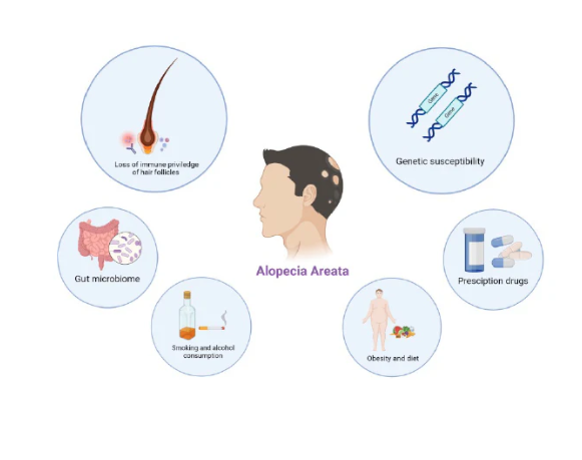
Participants will learn how the hair follicle normally functions as an immune-privileged structure, meaning it is protected from immune system attack. In alopecia areata this immune privilege is disrupted, allowing autoreactive T-cells to target components of the hair follicle. The resulting inflammatory process interferes with normal hair follicle cycling and leads to premature transition of hairs into the resting phase, causing hair shedding.
The unit also examines the genetic and environmental factors that contribute to disease development, including familial susceptibility, immune signalling pathways and inflammatory cytokines. Potential triggers such as infections, stress and metabolic factors are also discussed to illustrate the complex mechanisms involved in the onset of alopecia areata.
Unit 2: Epidemiology and Associations
This unit reviews the epidemiology of alopecia areata and the conditions commonly associated with it.
Participants will learn about the prevalence of the disease and how it affects both adults and children. The course also explores prognostic factors, including the age at onset and the severity of disease presentation. More severe variants such as alopecia totalis and alopecia universalis are discussed, where hair loss affects the entire scalp or the entire body.
The unit also examines associations between alopecia areata and other autoimmune and inflammatory conditions, including thyroid disease, vitiligo, psoriasis and type 1 diabetes. Atopic diseases such as asthma and eczema are also commonly associated. In addition, the psychological impact of alopecia areata is highlighted, with many patients experiencing anxiety, depression and reduced quality of life.
Unit 3: Clinical Presentation
This unit focuses on recognising the clinical features and patterns of alopecia areata.
Participants will learn about the most common presentation of patchy alopecia areata, characterised by well-defined circular or oval areas of hair loss. Variants of the disease are also discussed, including ophiasis, where hair loss occurs in a band-like pattern along the scalp margins, and diffuse forms that may mimic other types of hair loss.
More extensive disease patterns such as alopecia totalis and alopecia universalis are also explored. The unit also highlights additional clinical features including nail changes such as regular pitting and ridging, which can provide useful diagnostic clues.
Participants will also learn how to take a comprehensive patient history, including the onset and progression of hair loss, potential triggers and the psychosocial impact of the condition.
Unit 4: Diagnosis and Assessment
This unit explains the clinical and investigative approaches used to diagnose alopecia areata and assess disease severity.
Participants will learn how to perform a thorough scalp examination, including visual inspection and assessment of other hair-bearing areas such as the eyebrows, eyelashes and beard. Trichoscopy is introduced as an important diagnostic tool that can reveal characteristic findings such as exclamation mark hairs, black dots and yellow dots.
The unit also introduces validated scoring systems used to measure disease severity, including the Severity of Alopecia Tool (SALT). These scoring systems help clinicians monitor disease progression and evaluate treatment response.
Differential diagnoses are also reviewed, including trichotillomania, tinea capitis, telogen effluvium and early scarring alopecias, which can sometimes resemble alopecia areata.
Unit 5: Management Options and Factors in Decision Making
The final unit explores the range of treatment options available for managing alopecia areata.
Participants will learn how treatment decisions depend on several factors, including the extent of hair loss, disease activity, patient age and the psychological impact of the condition. In mild cases, observation and reassurance may be appropriate due to the possibility of spontaneous regrowth.
Medical treatments discussed include topical corticosteroids, intralesional corticosteroid injections and adjunctive therapies such as minoxidil. For more extensive or resistant disease, systemic therapies may be considered, including corticosteroids, immunosuppressive agents and newer targeted treatments such as JAK inhibitors.
The unit also emphasises supportive care strategies such as cosmetic camouflage, wigs, scalp micropigmentation and psychological support, which can help patients manage the emotional and social impact of hair loss.
Alopecia areata is a complex autoimmune condition with diverse clinical presentations and a variable course. By understanding its underlying mechanisms, recognising its clinical features and applying appropriate diagnostic and treatment strategies, clinicians can provide effective care that addresses both the medical and psychological needs of patients experiencing this condition.
*Medical Board of Australia's (MBA)'s Registration Standard: Continuing professional development (the Standard)