Finding accredited CPD
Every CPD activity will cost you valuable time. Not many CPD activities will give you something back. With SurgicalPerformance you will build a permanent, private record of your own surgical practice, and it becomes a more valuable asset every year you keep it.
Most surgeons operate without knowing their own outcomes. Complications are remembered rather than measured, the aspects of recovery that matter most to patients are rarely captured, and comparison against peers is rarely available outside a hospital or registry setting.
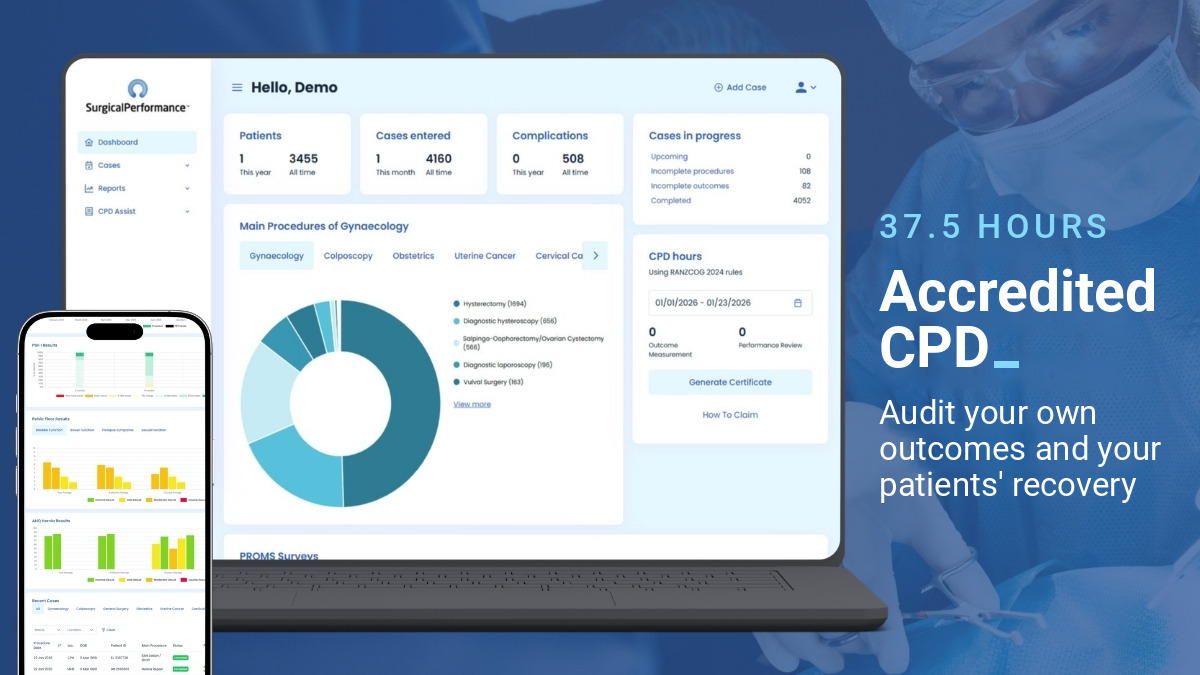
Reflect to Perfect is an audit of your own practice, completed on the SurgicalPerformance platform in two parts:
Your clinical outcomes (INSIGHTS). Enter your cases as you go, and the platform builds a continuous picture of your complication rates, readmissions, returns to theatre, adverse events and other clinical indicators, tracked over time and across procedure types. Your results are benchmarked against de-identified aggregate data from other surgeons on the platform, drawn from more than 295,000 logged cases.
What your patients report (PROMS). Choose which validated patient-reported outcome measures and satisfaction surveys to send when you set up each case. Surveys go out at intervals appropriate to the procedure, and responses flow back into your email inbox and your private SurgicalPerformance dashboard. PROMS will automatically alert you when patients report concerns (pain, loss of physical recovery and quality of life) across your practice and case by case.
Why choose this activity over another
One activity, one subscription, up to 37.5 hours of accredited CPD. That covers the full 25 hours the Medical Board requires across Measuring Outcomes and Reviewing Performance, with at least 5 in each, plus 12.5 hours more.
The case database you build is yours, and it compounds. A surgeon who starts this year has a decade of their own outcome data in ten years' time. One who waits five years does not.
It asks little of your time. You can scan the recovery of everyone you operated on last week, and in the weeks before, in under a minute. That minute surfaces patients whose recovery is not progressing as expected, sooner than their next appointment would show you, and patterns you would not otherwise detect, such as whether patients at one hospital report more pain or nausea than patients at another.
Objective data means your view of your results rests on measurement rather than recall. Being able to demonstrate that you systematically monitor your own outcomes is increasingly part of contemporary surgical practice, and it gives you something concrete to draw on in conversations with colleagues, hospitals and referrers.
Your data, and what your patients report, comes back to you and to no one else. It is not shared with your hospital, your college or your insurer, and it does not appear in any public rating.
Developed by Professor Andreas Obermair, a practising gynaecological oncologist, and in use by surgeons across Australia, New Zealand and beyond since 2009.
Your hours are calculated from the cases you enter with a surgery date in the CPD year. Each case can earn time in both categories:
Your full 37.5 hours is reached at 250 cases.
Measuring Outcomes hours are added automatically as you enter cases. Reviewing Performance hours are claimed once you confirm that you have reviewed and reflected on your cases.
Provided by
Educational Activities (EA) - 0.0
Reviewing Performance (RP) - 12.30
Measuring Outcomes (MO) - 25.0
You have to log in to see the content of this module.
*Medical Board of Australia's (MBA)'s Registration Standard: Continuing professional development (the Standard)